Hunting the lost Breweries of York
Leaving York Station and heading up towards Micklegate – I paused top look over the impressive sweep of York stations western approach and pondered the role the railways may have played in the topsy turvy history of brewing in York.
For forty years in the 20th
Century – York the jewel of the North was a city with no beer – well that’s not
quite right – there is of course a well known urban myth that York has a pub or
a bar for each day of the year and there are streets like Fossgate that you
could have a very merry day long pub crawl – but what I mean is that for Forty
years form 1953 (with the closure of JJ Hunts Ebor Brewery in Aldwark) until
the opening of the York Brewery in 1996 – no commercial pints of beer was brewed
in the fair city. The reason for this had led to a couple of deep debate on our
podcast MaltravAles – when we spent three episodes planning perfect post covid pub crawls
– yes there are that many good pubs that it took three episodes – and even then
we we only covered around 40 pubs probably less than a 1/3rd of the
pubs and bars in York still serving fine ales and spirits
Our debates had thrown out some possible reasons
– Nick favoured the medieval city plan meaning space is a premium in York – rents
are high and here is not much space left for the estate breweries need. Bruce
felt that the dominance of Rowntree’s in the city and particularly their Quaker
and therefore teetotal
 |
| Would you get a brewery dray through there? |
conformity may have led to a squeeze on the production
of the evil brew – I myself wondered about water and having recently done some
research into the Brewing capitals of Burton and more importantly Tadcaster – a
mere 14 miles down the road – the economics and transport infrastructure that
may have something to do with it – hence my gazing out over York Station with
its 11 platforms and iconic glass and wrought iron roof – when it was opened in 1877 this was the
centre of Britain rail network and the biggest station in Europe.This of course
meant that York was also the centre of Victorian logistics – linked to the rest
of the country by an efficient and for the time speedy transportation system that
could whiz people goods and of beer to and from the fair city.
On googling the history of brewing in York, I
found that there was not much out there and nobody had really got in the debate
that we had started about the reasons for the drastic decline in York brewing
in the first part of the 20th century. – and this sparked in me a
bit of a flame that I have been nurturing over the last year or so.
One name that did keep coming up when you
researched pubs and breweries in York was chap called Hugh Murray. This led to me,
spending a very enjoyable February day in the Archives section of York City
library reading the meticulous notes, newspaper cuttings that Hugh had put together
over meany years of recording and chronicling virtually every pub and church in
York.
Hugh Murray is probably the greatest York historian, though apparently he
hated history at school, though born in
Hull he attended school at St Peters in York, but turned it into a second
career after retiring from British Rail.
He was the fifth generation of
railwaymen in his family. His father Donald was fish stock superintendent for
the London and North East Railway (LNER). Hugh joined British Rail after
Studying physics at Oxford University, he became a signals and
telecommunications engineer at Norwich and later Leeds, and ultimately moved to
York to spend 14 years as signals engineer for the Eastern Railways region.
He amassed a vast personal
collection of thousands of books, newspaper clippings and photographs of York.
(Much of which is now held and able for public viewing in York Library – you do
need to books if you want a look. In 2004, Murray was presented with a British Association
for Local History award for personal achievement for his services to York’s
local history. He was an author and contributor to a huge range of publications
about York.
Murray sadly died of mesothelioma
in 2013, probably caught from from the asbestos dust and fibres in workshops
while he was a British Rail graduate signals apprentice in the mid-1950s.
More recently Andrew Davison had put together
some comprehensive audits and records of the development of brewing and the
general pub scene in the city particular focusing on the 18th and 19th
centuries and there were a number of guides to the very fine pubs of York – but
nobody appeared yet to have really got into why the city became beer less,
especially when Tadcaster 10 miles down the A64 dual carriageway could claim to
be one of the Brewing capitals of the world!
Andrew Davison in his paper A genuine and Superior Article: the
Last two centuries of Brewing in York starts with a fine abstract that gives a
good overview of York’s brewing history “Walking the streets of York, the
passer by might be forgiven for overlooking the fact that the indigenous brewing
industry had ever existed. There are certainly plenty of outlets for beer, but
the brewers names which appear on the city’s hotels and public house are those
of regional and national companies and the nearest breweries today are to be
found a dozen miles away. Yet beer was brewed in York for hundreds of years,
and the last of the City’s major breweries closed less than 4o years ago.”
On reaching the busy crossroads at the Micklegate – a good stop
to consider Nick’s point re space in the medieval town it would be hard getting
brewery Drays through those Bars and resisting the temptation to nip in to
Wetherspoons Punch Bowl (this building has been a pub since 1783 when it was
known as the Fox and Hounds) or start down the Mickelgate run - one of Yorks
more legendary pub crawls – though with the closure of Brigantes and the York Brewery
tap less appealing than it use to be, unless you want Brewdog and a Pubco’s a
plenty. I turned right up Blossom street and the Tadcaster road – there that
brewing mecca again on the look out for a convent and two former brew pubs.
The Bar Convent is easy to spot and also now offers quite nice accommodation
– there apparently, was a brew house here in the 17th century but
only for the nuns –
 |
| Bar Covent, York |
The Bar convent is the oldest living convent in the uK established
in 1686 as a school for girls – it is a Grade 1 listed building but what ‘s the
link to pubs and beer?– well read on – the pub opposite the Convent and dominates
the corner of this large cross roads is the Windmill – clearly a coaching inn of
days of yore
 |
| The Windmill, Blossom Street |
The
Windmill in Blossom St, first recorded as a pub in 1769.
Press records reveal frequent use for sales of livestock and property. In 1893
it still had its own brewhouse but was then bought by a commercial brewer,
Brett Bros., who had a brewery in Spurriergate. They paid £3,750 for the pub,
which is a fairly substantial £474,000 in today’s money. Even by 1902 it still
had 16 letting bedrooms. By the 1970s it became part of the then
well-known Berni Inn steakhouse chain. The Windmill’s pub sign
is worth a look portraying the preserved Holgate windmill in York given away by
its unusual set of five sails.
Picture Source Clements Hall Local History Group -
Boozing, Booze and Boozers in our Area (clementshallhistorygroup.org.uk)
 |
| The Bay Horse - once owned by nuns |
A
little further down Blossom Street and across from the Everyman Theatre, is
another ancient York pub – The Bay Horse -originally a farmhouse dating from
the 17th Century – there are a few suggestion behind the name – a
current plague on the outside wall of the pub mentions Cleveland Bay horses –
but most York historians suggest the name of the pub is linked to a famous race
horse Malton Bay (nice link to the podcast) – the horse won the Gim Crack 500
Hundred Guineas Race at York in 1765 – at the the time this was one of the
biggest races in the world. So whats the link between pub and the Convent down
the road – well records state that between 1862 and 1874 the pub was actually
owned by the Nuns at the convent – The nuns had started to lend out small amounts
of money to help people set up in
business in York unfortunately one these loans had ended in bankruptcy and the
Pub had been used as collateral for the loan – the Convent sold the pub in
1874. A Map of York brewers in 1850 in the Davison paper lists the Bay Horse as
a Public House Brewery – one of four public house on Blossom Street alone – the
same map of 1850 lists 13 Common Brewers and 47 Public House Breweries in York.
I had a quick mooch around the back of the pub to see if there were any brewy
remains – a few chimneys and a nice beer garden were all I could find.
 |
| Rear of The Bay Horse, Blossom Street. |
Retracing my steps towards Micklegate – the
next target was Nunnery Lane which runs parallel to the Southern wall towards Clementhorpe
– there are still a couple of pubs still open down Nunnery lane – plus a few
still standing relics – the 1850 map also shows a brewery owned by J.F Kilby at
the junction with New York Street. The 1875 map shows that the Brewery had gone
but the Victoria Vaults still standing was listed as a Public House Brewery
Other Maps in the Davison list the Brittania, Nunnery Lane as a Hothams tied house in 1875. The first current pub you pass on
the way down the Lane is the Trafalger Bay – a Sams Sith pubs that gets a regular
mention on the Podcast – had been closed for a time during Covid but good to
see it open again – Hugh Murray’s Directory of York Pubs 1455-2003 states that
pub was formerly the Britannia mentioned above, the building itself dates back to
around 1837, again as with many York pubs there is some debate about the Pubs
name – Horse or famous naval battle – a horse call Trafalgar By with local
connections was 2nd in the 1806 Derby and ent on to win a number of
prize races just up the road at York racecourse. Murray points out that the pub
sign outside depicts Trafalgar as it actually is a headland and not a bay. Records
show that when the pubs was offered up for sale in 142 the premises included a
brewhouse.
Further down
Nunnery Lane is the Victoria Vaults listes as a Brew pub firt mntioned in 1857
– still going string by the look of it though I mist sa not a pub I have everr
vsisited – What Pubs gives an interesting description Low key local pub with well-kept real
ales. Clean, vintage interior with two good sized rooms and friendly staff.
Music/karaoke events most nights. Covered outdoor area for smokers. In 2020 the
bar was turned through 90 degrees parallel to the front wall and the two rooms
knocked through into one with a stage for groups at the far end. Reports suggests it usually stocks a range of
locally rewed beers.
 |
| Site of the old Kilby Brewery? |
Arriving at the what I thought would have
been the junction of New York Street linked to the old Kilby Brewery – the
street no longer exists but looks like it was near where nunnery lane forks –
again there appeared to be no sign of any lingering brewery buildings
A bit further down is the rather for lone Old
Ebor listed as a Beer house in 1869
 |
| The Old Ebor - soon to be flats |
Beer houses were established as a result of
the Beerhouse Act of 1830 which was passed to encourage people to drink beer
rather than sprits such as gin which had caused so much wreckage especially
amongst the lower classes – beer houses were only licensed to sell beer and
ale, the act also abolished beer tax and allowed the hose to be open for 18
hours a day – so I’m not sure it really stopped the lower classes drinking themselves
to oblivion to escape the harsh realities of Britain in the 19th
century.
A recent news report in York suggest that its
days of the Od Ebor as a pub are over despite a last minute intervention by York
CAMRA –
A York pub is set to
be turned into two new homes – with the owners saying the venue is not viable
due to coronavirus restrictions.
The Old Ebor, on the corner of Nunnery Lane and
Drake Street, was listed as an asset of community value (ACV) by City of York
Council following an application by the York Campaign for Real Ale. But
community groups had until June 3 2020 to express an interest in buying the
property.
A planning application has now been submitted to the
council asking for permission to turn the pub into two flats.
Again
a pub I have not frequented – maybe a shame, a TripAdvisor report sates “The
old Ebor is a hidden gem of a no frills good pub serving the local community
with a selection of well kept ales.”
Arriving now at
the bottom of York hippest street – Bishopthorpe Road or Bishy Road if you have
a beard, ride an ebike and actually know what a falafel tastes or even looks
like – it has its far share of watering holds though most quite modern as the Temperance
folk were quite active around this area of York in Joseph Rowntree’s days – especially
one Canon
George Marsham Argels who was the the vicar the local parish of St Clements
Again I quote
from the very thorough Clements Hall Local History Group -
Boozing, Booze and Boozers in our Area (clementshallhistorygroup.org.uk)
Canon
Argels and his cohorts figure prominently in reports of the licencing justices
considering and then refusing to grant or extend licences. One example was the
attempt in 1900 by J. J. Hunt Ltd. to get a licence for a pub at one end of
South Bank Ave (which, at this time, would have been undeveloped). Despite
clear evidence of significant nearby development, the licensing bench agreed
with Argles that the necessity for a new licence had not been proved. Another
thirty-two years were to pass before the alternative view prevailed.
Opposition
to pubs in the South Bank area also expressed itself in the deeds to land on
which houses were built in the 20th century. My own deeds record the following
restrictive covenant seeking to prevent any owner from using any building on
the land as 'a Public House or Beer House or for the sale of intoxicating
liquors either in clubs shops or otherwise.' This temperance related activity
explains why South Bank had to wait until 1932 before it got its first public house.
Clementhrope Maltings were next on my hit list
– down some quite attractive terraced streets near to the Ouse – Clemonthorpe
Brewery was closed in 1858 and the site was later occupied by
Terry’s first
chocolate factory in York, itself demolished in the 1980s and replaced by housing. However the brewery
maltings are still standing, though they again are now residential apartments
Just a couple of streets away is a York Pub
that’s always well worth visit the Slip Inn – again featured on our York
podcasts – named after the slip way at the bottom of the street that use to
send Terry chocolates all over the Empire. Another pub listed by Davison as
being a former Public House Brewery in the 1800’s
 |
| The Slip Inn close to the site of the former Clementhorpe Brewery |
Heading back to the city centre and the Walls
– another former Public House brewery and regular York haunt of the podcast is
the Swann dating from around 1892, listed as beer house in 1902 – It was owned
by Tetley’s (made a Tetley’s heritage pub in 1985) until the 1989 ‘Beer Orders’
were brought in, which forced the big brewers to break up their estates. It was
then taken on by ‘pubco’, Punch Taverns
with their associated ‘beer tie’ that meant landlords had to buy beer from Punch
at increasingly inflated prices.
 |
| The Swan - a cracking pub |
Landlord of the Swan at the time, Paul
Crossman, became a committed campaigner for fairer terms for pubs and was one
of a number of licensees heavily involved in the national ‘Fair Deal for your
Local’ campaign, which won a big legislative victory in November 2014, when
Parliament backed legislation on the tied pub sector with a statutory Pubs Code
backed by an Adjudicator.
This finally gave licensees the chance to
challenge their tied deals for the first time, and enabled Paul to secure a new
‘free of tie’ deal at The Swan. Punch Taverns then sold the freehold ownership
to Heineken UK.
The Swan remains a great community pub with an
ever changing choice of great beers from far and wide – I always think of it as
the perfect Saturday afternoon pub to read the papers and sample some fine
ales.
Walking overt the River a quick diversion to a
thronged Kings Staithe – the weather was now very warm and sunny – next task
was to have a look for any remains of the Friar Gate Brewery – had a number of
owner but laterally one of York’s big brewers Hothams who had added this
brewery and the associated 7 tied houses (Including the Spread Eagle) in 1875.
Hothams in turn would in turn become the Tower Brewery and shortly depart the
city for better water and prospects in nearby Tadcaster.
Friargate
is a short street which connects Castlegate to Clifford Street, but it once
formed part of Hertergate, which was one of the infamous Water Lanes. The
Friary which was the street is named after was a Franciscan Friary which
existed here from at least the twelfth century. The Water Lanes were plagued
with diseases and were the centre of the city’s cholera epidemic in the early
1830s not perhaps the best place for a brewery.
The brewery closed in the late 1800’s but I
think the photos I took suggest some of the core buildings remain – though
there does not appear to be much written about this area.
It was time to meet up with Bruce, so I headed
back past Clifford’s Tower and over York’s second river the Foss – which wasn’t
looking particular picturesque by the back of the big Wetherspoons and snook in
through the walls to the very fine Phoenix a little oasis of calm away from
York’s inner ring road on the other side of the medieval wall.
The Phoenix
Originally
dating back to the late eighteenth century - its front arrangement of public
bar (originally the 'best smoke room'), side corridor with stand-up lobby, and
top-glazed dividing screen, stemming from 1897 designs for John Smith's brewery
by Tadcaster architects, Bromet and Thorman.
 |
| A fine pint in the Phoneix |
Adjacent to
the often forgotten smaller Fishergate bar, The Phoenix Inn is the last
surviving pub inside the city walls which served the old cattle market, held
within Fishergate Bar until 1827. It may have taken its present name from the
Phoenix Iron Foundry, which was situated behind Fishergate Postern. In the
early part of the nineteenth century the pub was known as the Labour in Vain
and later became the Phoenix, taking its name from the Phoenix iron smelting foundry
which stood opposite the pub in the mid 1800’s.
The pub was
bought by Tim & Val Everton in 2008 and following a year of sympathetic
restoration, the pub re-opened in October 2009.
After a
morning of hot wandering around York’s southern suburbs, I was, certainly ready
for a pint and went for a refreshing Saltaire South Island, a New Zealand pales which do seem to be all the rage at the
moment. Though the pub was surprisingly quiet for an August Bank holiday Sunday there was a bit of a
queue at the bar and the guys in front on me had just ordered 4 pints of
Landlord which had finished off the barrel – no problems said the barman there
is another ready for tapping and when he pulled of the first couple very fine
they di look – so when Bruce and his daughter arrived shortly afterwards – I
asked Bruce to get me one and have got to say its was the Best pint of LL I
have had for a while and almost took me back to the Keighley of the 1990’s.
Resisting the
temptation for a Phoenix pork pie we downed pints and headed towards towards
Walmgate – passing the sad looking, Brown Cow set in a slightly surreal mini
post war council house estate that’s feels out of place in what is a fairly
ancient part of the city . The Sam Smiths pub did briefly reopen in July 2020
after a lengthy closure but looks like its closed again.
 |
| The sad sight of the closed Brown Cow |
On reaching
Walmgate, Bruce regaled his daughter with tales of the legendary Cat o’ 9 tails
- a whole French baguette filled with beef and onion gravy, served at our former Walmgate drinking haunt,
the Spread Eagle, one of Yorks 1st proper real pubs and one we
frequently imbibed within during the late 80’s – it was closed as a pub in 2020
and is now a restaurant called Yemeni Heaven
 |
| Site of the former Crown Brewery, Walmgate? |
The plan here
was a brief nod to the every expanding Brew York estate also on Walmgate – covered elsewhere but the aim today was to try
and see if we could see any evidence of the former Crown Brewery that had
operated on Walmgate in the early 1800’s – Todd is a name associated with this
brewery but again, there is very little reported or written about it – using maps
from the Hugh Murray collection in the library I had identified the brewery
site being somewhere around the present junction of Margaret Street and
Walmgate – but again not much to see amongst the ‘modern’ housing and shops.
So it was on to a brief pause
from
brewery hunting and to sample to faux York history with a trip back to Jorvick
(York’s Viking name) and my first trip to Valhalla on a fantastic medieval street Patricks Pool, by
York’s world famous shambles (though now more Diagon Alley than Medieval
butcher’s row) and market place.
Valhalla is a
Viking Themed bar in what was the Papillon hairdressing salon. Although the current building itself, isn’t that old – the
original building on the site burned down a few decades back – its ben done out
as a Viking drinking hall with ancient wooden beams for the ceiling and other
antique fittings sourced from reclamation dealers.
There was a brewery on this short street in
the 1800’s -Emmanuel Siddal opened a brewery in 1830 but it was closed in 1834
– sound like they had a real struggle selling beer to pubs in York many even
this early were tied to the bigger more established brewers such Hothams.
I tried a Valhalla Pale – there is normal a
couple of house ales on, these are brewed by the Half Moon Brewery based out at
Ellerton, a small village South East of York – a family run micro brewery
housed in an original blacksmiths that’s been in operation since 2013. Bruce
chose a Budweiser that great beer of the vikings.
From their we headed through thronged York
Streets towards Kings Square – we ducked down St Andrewsgate, good to see the nearby York Brewery/Black Sheep Last Drop Inn
was open and looked to be doing good trade.
St Andrewsgate, is another hidden York gem – a
fantastic cornucopia of buildings spreading pretty much the whole of York’s
history – this in turn morphs into Aldgate seeking the remains of perhaps Yorks
most famous brewer Johnny Hunts – the Ebor brewery once a York landmark was
demolished in the 70’s and unfortunately theres not much left. So a quick mooch
up and down a glance at the ancient Merchants Taylors Hall – York medieval guilds are a whole other story and maybe another
book of future. One of the remaining guilds - The Scriveners now hold the Assize of Ale every August, which
these days is a fundraising pub crawl in medieval dress for the charities
chosen by the guild.
Hunts was bought out by North East brewer Camerons in 1953, they carried on brewing in York for a short while, but by 1856 brewing ceased and the building was just used for storage until it demolision in 1972 and the site was redeveloped for housing
More luck on the oddly named Ogleforth – just
beside the Minister – the former March’s brewery is in much better health and
most of the buildings have been retained though now swanky apartments with the
Minister as your window view – nice place to retire to. This brewey was owned and run by John March, On March's death in 1880 another York brewing comnpay Thackwrays, took the brewery over - they had their head quarters in York pub, The Three Tuns which is still going next to Coppergate - . Thackerays were bought out by John Smiths in 1905 and brewing gradually transferred to Tadcaster. Brewing ceased completely on the Ogleforth site in 1940 and the buildings stood derelict until the residential refit was done in 2009

We walked back through to Goodramgate, Bruce
and Evie joined the queue for Roberto’s Gelato, while I went for a mooch around
another childhood icon the Monk Bar Toy shop – still with working train set in
the window in the shadow of the Monk Bar – recent research into York’s
brewing history had thrown up this was also site of another former brew house but again not much evidence left now.
Time was getting on so we shot off back across
York’s centre with a quick detour to Next on Coney Street, site of York’s first
named pub, – The George – took a quick photo of the plague and then back up
Coney Street dipping down Church Lane to have a look at the former brewery
buildings that now house Yates Wine Bar – part of the JJ Hunts brewing Empire-
last used by Camerons as a warehouse
 |
| Yorks first recorded public house- The George Inn |
In
the 1980’s Cameron’s stripped out the riverside warehouse and worked with Chef
and Brewer to create The Tavern In The Town, a new super-pub boasting seven
bars, two restaurants and a coffee house, across three floors. The whole site
had capacity for 1,500 people and the Evening Press
said the venue was the biggest pub in the north of England.
The
photos do still capture the warehouse features – we were not tempted to pop
inside – though Yates do normally have at least a couple of cask ales on in
most of their venues.
Heading
back up Micklegate and then Blossom Street we had arranged to meet Nick at The
Fox after he finished work and to spend some time at the beer festival they
were holding over the bank holiday.
On
reaching Holgate we stopped at one of Bruce’s regular locals the Crystal
Palace, a Sams Smith house set in the middle of a fine Georgian terrace and
does indeed look very house like and with usual Smiths modesty many would go by
not even knowing it was a pub. One of Sams rules is no children in the pub so
we took a table in the front beer garden – we both started on Taddy lager but
Bruce mentioned that the Old Brewery Bitter had been on good forms, so I tried
one and was pleasantly surprised by how good it was.
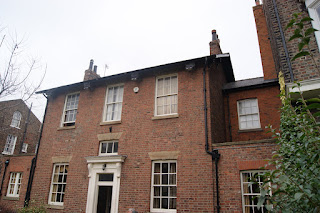 |
| The Crystal Palace - yes it serves beer ! |
Records
show that building was owned in 1851 by a Alf Dickinson who ran a wine and spirits
vaults from rather building – it is recorded as a pub from 1872 and is named
after the Exhibition held in London’s Hyde Park in 1851 and is a Grade II listed
building.
I
was then another short walk to the Fox – the largest beer garden in York was
pretty full for what was now early evening there was around 20 beers on – with
a festival bar set up in in the garden. We had an initial beer in the garden – I
kicked off with a Salt Raistrick an American Pale Ale which was good – we then moved inside as we
thought the beer offer in was better than those on the outside bar and took over
the little rear room behind the bar and
had a few samples of the beers on offer, before heading over the Bruce’s for a
very nice Chilli.
The
Fox’s current building dates back to 1878 and is also Grade II listed – however
an earlier pub the Cross Keys stood on the same site since 1841. The Fox was
built to service the nearby railway carriage works which at its height employed
over 5,000 people. Tetleys bought the pub in 1899 for a fee of £16k (now would
be £2.2 million) so there was obviously a good trade to be had. It was granted Tetley’s
heritage status in 1984 and had a big refurb in 1985 – it is now owned by Ossett
Brewery and well worth a visit, number of
bus routes from the city centre stop right outside.
All
in all a great day in York – really interesting mooching around some of the kisser
know streets and areas of York – reminded what a great place it is and the
thought that you would never get bored
walking around the place and /or popping into one of its very many fine pubs –
I will be back soon.
We
talk about our August day out in York in Episode 42 of the MalTravAle podcast https://malttravales.podbean.com/


